Frequently
Asked Questions
Here are the answers to the most common questions
that people ask me about Cocker Spaniels
|

|
Here are some of the questions most frequently sent to me, along with a reply from my team of experts.
(The team being comprised of me, myself, and I.) I'll start with the most common questions that I get
(questions about buying one of our puppies) but if you want to skip ahead you can go directly to
general questions about Cocker Spaniels (including training and health questions),
questions about buying Cockers from other breeders, questions about
getting in to breeding dogs, and questions about our web site.
- Do you have any puppies available?
No. We retired from breeding after our final litter in
2010.
-
 When will you have puppies available again?
We're not going to be having any further litters of
puppies.
- Why did you retire from
breeding?
We wanted to have more freedom to travel and enjoy vacations
without having to worry about dogs back home. We also wanted to get back to
a simpler time in our lives where we can spend our energy on relationships with
family and friends, rather than on dogs and online dog fanatics.
- Do you know of any good
breeders that have puppies available right now?
Sorry, but no. We really aren't even in touch with
the Cocker world anymore. We've moved on to other interests.
- Can you give me any tips on how to give my Cocker a proper hair cut?
I'm getting tired of paying the big bucks to a professional dog groomer, and I'm thinking about trying to do the job
myself. Is there a step-by-step instructional video I can buy somewhere?
 So many people have asked me that question over the years that I finally decided I couldn't stand it anymore! In 2007, I created an
instructional video on how to properly groom a Cocker Spaniel, and sold it as a DVD.
A few years ago, I decided that I had made enough money from sales of the DVD
that I had been more than fairly compensated for the effort it took to create
it. So, I decided to start making the instructional video available for
free on YouTube. It's actually a 7-part series of videos on YouTube.
So many people have asked me that question over the years that I finally decided I couldn't stand it anymore! In 2007, I created an
instructional video on how to properly groom a Cocker Spaniel, and sold it as a DVD.
A few years ago, I decided that I had made enough money from sales of the DVD
that I had been more than fairly compensated for the effort it took to create
it. So, I decided to start making the instructional video available for
free on YouTube. It's actually a 7-part series of videos on YouTube.
For more information on the free instructional grooming videos,
click here.
-
I live in (name of distant state or country) and there are no Cocker breeders here. Could you ship me
a pup? I'll pay you a ton of money.
Even when we did have puppies available, we would never ship
one. Can you imagine how traumatic it would be for a pup to travel in a
crate in the cargo hold of a jetliner? Our policy was always to place our puppies
with people within driving
distance. If you think I'm exaggerating the cruelty of shipping dogs by air...
read some horror stories here.
-
I've seen web sites with Cocker puppies for sale for only $500. Why do
some breeders get in excess of $2000 for theirs?!?!
Do you want an inexpensive puppy... or a healthy, well bred, and well socialized puppy?
Good Cocker breeders incur
some significant expenses on the road to breeding healthy puppies. For example, all the costs associated with doing the OFA and CERF testing to lower the chances that
the puppies will grow up to have hip or eye diseases. You might be
thinking "those tests aren't that expensive!"... but what you aren't thinking about is all the expenses involved
in removing a dog from a breeding program if he or she fails those tests.
As an example... In 2008, we spent about $4000 in
veterinary expenses on Reese after she failed a CERF test. Then in 2010,
another dog from completely different lines failed a CERF test. There
are hugely expensive consequences to doing the testing, if someone fails the
tests! Which is one reason that a lot of breeders don't ever do the
tests... they don't want to know!
- I see that you live in
California. That's a big state. Where exactly do you live?!?!
Actually, we moved out of California in 2020 after I
retired from my "real job". We now live in Pasco, Washington. If you
see anything on this web site that says we live in Grover Beach, California...
it's a page that has not been updated since our move.
- What is your phone number? I want to call you to ask you some questions about
Cocker Spaniels, but I don't see your phone number anywhere on your web site.
 It's not posted here for a reason. Several reasons, actually. First, people tend to make calls when it's convenient for
THEM, and that's inevitably not at a convenient time for ME! Second, I
simply have moved on to other interests besides Cockers in the years since we
retired from Cocker breeding. It's an unwanted intrusion when someone
contacts me with a Cocker-related question these days. I enjoyed the years
that Cockers were my hobby, but that was quite a few years ago and I'm in to other
interests now.
It's not posted here for a reason. Several reasons, actually. First, people tend to make calls when it's convenient for
THEM, and that's inevitably not at a convenient time for ME! Second, I
simply have moved on to other interests besides Cockers in the years since we
retired from Cocker breeding. It's an unwanted intrusion when someone
contacts me with a Cocker-related question these days. I enjoyed the years
that Cockers were my hobby, but that was quite a few years ago and I'm in to other
interests now.
An easy way to irritate me is to do a little detective work, find my phone
number, and call me with a question about Cockers. And don't even
think about showing up at our front door "because you're in the area"!
We're just not interested in entertaining every Cocker lover that happens to be passing
through the area on vacation!
-
I have a female Cocker, and would like her to have a litter of puppies. Do you have stud service available?
No. We retired from Cocker breeding in 2010. We
don't own any male Cockers at all, just one spayed female who is our pet and
will never be bred.
- Are Cockers good with kids?
 It is a very kid-friendly breed. Cockers love people... it's as simple as that. A kid that
will throw a ball and take the dog for walks is bound to find a very good friend in a Cocker Spaniel.
It is a very kid-friendly breed. Cockers love people... it's as simple as that. A kid that
will throw a ball and take the dog for walks is bound to find a very good friend in a Cocker Spaniel.
There are a few things to watch out for, though. First, if you're buying a puppy, get one that has
been properly socialized with kids. Second, an exuberant Cocker can easily knock down a toddler,
so adult supervision is definitely suggested with very young children. Finally, if you're thinking
of adding a new puppy to a family with a pre-schooler, I'd advise you to wait just a few years. My
experience has been that kids under the age of six just do not understand how gently you must treat a young
puppy. After the kids are six or older, they make a perfect fit with a Cocker Spaniel.
-
I'm having a hard time potty training my Cocker Spaniel. Can you give me any tips?
Make sure you are taking him to the same place outside every time. Find a nice patch of lawn, and make
that his designated potty spot. In time, as he gets used to that one spot, and smells his old urine there, it will get a lot
easier to have him go there. Clean up all accidents in the house extremely well, so he doesn't smell the urine there later.
As you get to know him better over time, you should start to notice some patterns... a pattern of when he pees and poops,
and a pattern of how he acts just before peeing or pooping in the house. If you pay close attention to the patterns, you will
have a lot easier time preventing accidents. Think preemptively... in other words, anticipate! Generally, a puppy
needs to pee or poop just about every time they wake up from a nap. And usually you'll see some patterns develop concerning
when they poop... as you get to know the dog you will see start to learn his poop schedule. Also, just as you can not
just command your body to poop at any given time, neither can the puppy. So sometimes you have to spend 10 or 15 minutes out
on the lawn with the pup when you are reasonably sure that there's something due about now.
There are more suggestions listed on my potty training page.
In addition, there is a good article about crate training dogs at
labradortraininghq.com
-
What is the difference between an American Cocker Spaniel and an English Cocker Spaniel?
An English Cocker Spaniel doesn't go potty, he uses the loo.


 OK, seriously, the American Cockers are smaller than English Cockers, and have a shorter snout. If you ever
see a dog that looks like a big Cocker with a goofy long nose, you're probably looking at an English Cocker.
Look at the differences in the snouts of the two Cockers pictured here, and I think you'll see it.
OK, seriously, the American Cockers are smaller than English Cockers, and have a shorter snout. If you ever
see a dog that looks like a big Cocker with a goofy long nose, you're probably looking at an English Cocker.
Look at the differences in the snouts of the two Cockers pictured here, and I think you'll see it.
The coat coloring of the two breeds tends to be different, too. While buff, black, brown or parti colors
are common in the American Cocker... the most common coat color in the English Cocker is the blue
roan. If you'd like to look at some pictures of English Cockers, including
some blue roans, click here.
This subject reminds me of another joke about Cocker Spaniels... which you'll only get if you
appreciate the differences in the faces of the two breeds...
An English Cocker Spaniel walks in to an American Cocker Spaniel bar... and the bartender says:
"Hey, why the long face?!?"
-
We're having a problem with our new puppy. Whenever my husband comes in to the room
and plays with the puppy, the puppy pees. What is going on here?
This is called submissive urination. When the puppy feels threatened or scared in the presence of a
bigger more dominant animal, she loses control of her bladder. Some puppies will grow out of this,
others never do. Your husband needs to be careful to use a soft voice when talking to the dog, and
to avoid towering over the dog. Have your husband bend down to the dog's level whenever possible.
An even more common problem in Cockers is excited urination. This is where the dog loses bladder control
when it is very happy... for example, when you come home from work and greet it for the first time,
or when you have visitors over and they greet the dog. My very first Cocker had this problem, and I
can tell you that it's really annoying! I personally am trying to breed puppies that do not have
this problem... although sometimes it does happen even with the best bred dogs. The problem is more
common in females than in males, and many puppies that have this problem will grow out of it as they get
stronger and get better bladder control.
You can read more about submissive and excited urination
here.
-
Every time we go to the vet, he tells us that our dog has an ear infection.
We can't seem to keep these darned ears clean! Do you have any advice for us?
Two pieces of advice, actually.
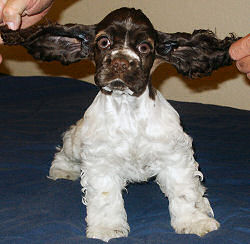 First, keep the hair trimmed on the underside of the ear in the area within a
few inches of the ear canal. I'm talking about the side of the ear that
touches the head, not the side of the ear that shows. If you allow the
hair to grow in this area, it blocks the ear canal and promotes infections.
Keep all hair trimmed in this area to promote air circulation in to the ear.
First, keep the hair trimmed on the underside of the ear in the area within a
few inches of the ear canal. I'm talking about the side of the ear that
touches the head, not the side of the ear that shows. If you allow the
hair to grow in this area, it blocks the ear canal and promotes infections.
Keep all hair trimmed in this area to promote air circulation in to the ear.
More importantly, keep the inside of the ears clean. We used to spend a
lot of time using cotton balls and expensive cleaning solutions to clean ears.
It was a big hassle, and we hated doing it. Then our friend Dawne Christy,
who has way more experience with Cockers than we do, shared a little trick with
us. It seems she had a secret recipe for ear cleaner that you can make
yourself using ingredients available at Rite Aid or most other large drug
stores. If you squirt some of this concoction in to the ears once a week,
I think you'll start having a lot less problems with ear infections.
Click here for the secret recipe.
-
My Cocker has an annoying behavior problem. He is constantly (fill in problem here...
barking, chewing, jumping, etc.) Any suggestions?
There is a very interesting web site operated by the University of Wisconsin at Stevens Point that features
links to all sorts of articles about canine behavior problems. There are fifteen specific behavior
problems listed, as well as a few general issues. I think you'll find the articles quite useful.
Click here to go to the site.
I'd also like to point out the single most powerful word in the English language
when it comes to dog training. That word is "NO!". When your dog
does something you disapprove of, use the word "NO!" in a stern voice.
In situations where the word "NO!" doesn't work, you'll find a really
good way to put a quick stop to any Cocker behavior is a shot in the face from a
squirt gun. After a while, just the sight of the squirt gun in your hand
is usually enough to stop the behavior.
-
Am I better off to have a pair of Cockers, or just one?
If the dog will be alone for long periods of time (for example, if you work all day) Cockers seem to do
better if they have a companion. If the dog is going to be with people most of the time (for example, you are retired) you might
be better off with just one... he or she will become TOTALLY devoted to you. If you are going to have a pair of
Cockers... a male/female pair has the highest chance of getting along without fighting. A pair of females is the worst
combination... they tend to have the most frequent conflicts. Not to imply that two female Cockers can't get along...
I'm just saying the odds are more in your favor with a neutered male and a spayed female.
-
I am getting tired of paying all that money to a groomer to trim my dog, and am thinking about doing the trimming
myself. What equipment do I need to do the job right?
Trimming the dog yourself is a great idea, and I definitely recommend it. Getting clipped at home by
the person they trust the most is a lot less stressful for the dog... and because it's so much more convenient for you,
you'll probably find yourself grooming the dog more often. If you're unsure of how to give a Cocker Spaniel a proper haircut,
you'll probably find my instructional Cocker grooming videos quite useful. I made
them to show people like you exactly what you need to know about
properly grooming a Cocker Spaniel. Click here for details.


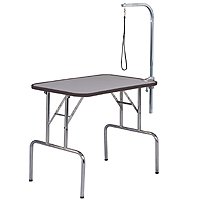 Start by buying yourself a good pair of electric clippers and a grooming table. Yes, this will cost you some $$$ up front,
but you will quickly recoup it by not having to pay for grooming services. What I recommend you buy is a pair of
Andis AGC-2 electric clippers with a #10 blade.
Start by buying yourself a good pair of electric clippers and a grooming table. Yes, this will cost you some $$$ up front,
but you will quickly recoup it by not having to pay for grooming services. What I recommend you buy is a pair of
Andis AGC-2 electric clippers with a #10 blade.
A
grooming table will get the dog up at the right height for you to work... and if you get a grooming table with an arm and
a noose, you'll have a lot less trouble keeping the dog still while you trim. If you're seriously short on $$$, skip the grooming
table and just buy the electric clippers for now... you can just groom the dog on whatever table or stand you have already.
But it's money well spent if you can afford to buy the grooming table right away.
Click here to see other products that I recommend for Cocker Spaniels.
When the subject of electric clippers comes up, an awful lot of people complain that the blades get hot or that the clippers just
don't work very well. Almost always, this is their own darned fault! Read the manual, and notice how they stress the
importance of LUBRICATION. The blades literally rub metal against metal, and without proper lubrication this will create
excessive heat and also a loss of cutting ability. Use the lubricating oil that comes with your clippers... USE IT BEFORE
EACH TIME YOU USE THE CLIPPERS. Use the spray-on Kool Lube product after every ten minutes or so of clipping. With proper
use of the lubricating oil before clipping, and Kool Lube during clipping, your electric clippers will work much better.
-
I've heard Cockers described as hyper, nervous, or high strung. Is that true?
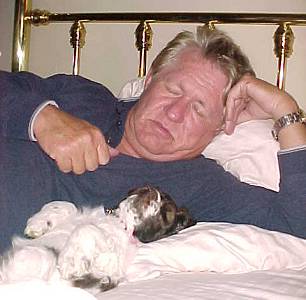 My experience has been that the more time a Cocker gets to spend with his owner, the calmer and happier
he will be. The most mellow Cockers I have ever met have been owned by retired people who have the
luxury of having the dog with them almost constantly. The most agitated Cockers I've known have
been banished to the back yard all day while all the humans in the family are at work or at school.
It drives the dog nuts... they crave human companionship. This is why I try to place my puppies
in homes where someone is at home most of the time.
My experience has been that the more time a Cocker gets to spend with his owner, the calmer and happier
he will be. The most mellow Cockers I have ever met have been owned by retired people who have the
luxury of having the dog with them almost constantly. The most agitated Cockers I've known have
been banished to the back yard all day while all the humans in the family are at work or at school.
It drives the dog nuts... they crave human companionship. This is why I try to place my puppies
in homes where someone is at home most of the time.
My #1 tip for creating a mellow Cocker: Let it sleep on your bed at night. They absolutely love
this! It helps create a special bond, it makes them feel very secure, and you will definitely
have a better behaved Cocker this way.
- I just bought an 8-week-old
puppy and he has a full tail. At what age should I get it docked?
It's already too late. The breeder should have had the tail docked at the
age of 3-5 days, before the nerves in the tail were fully developed. It
can be done very easily and with minimum pain to the dog at that age.
Even though your puppy is only a couple of months old now, his tail is already
very sensitive. It would require surgery with anesthetic to dock that tail
now. Enjoy his unique full tail as it is, rather than putting your dog through surgery.
- What is the average lifespan of a Cocker Spaniel?
To make a very broad generalization... let's say 12 or 13 years is about average.
Keep in mind that one dog year is roughly equivalent to seven human years.
There are definitely people who have had Cockers that have lived to be 15, 16, 17 and even 18 years of age. You
can talk to some of them on
our Facebook Cocker group. But Cockers that make it
to 15 are few and far between. 12 or 13 is a more reasonable lifespan to expect from your dog. If you do
have a Cocker that has lived to be 15 or older... give yourself a big pat on the back... because as far as
taking care of that dog goes, you're probably doing just about everything right!
- How can I stop my Cocker from barking?
 The best way to deal with the barking problem is to not let it get started in the first place. From the
very first time you ever hear the dog bark as a puppy... if you firmly say "no" to the dog
each and every time you hear him bark... you can usually nip it in the bud. Just be firm and NEVER
let the puppy get away with barking without a firm reprimand.
The best way to deal with the barking problem is to not let it get started in the first place. From the
very first time you ever hear the dog bark as a puppy... if you firmly say "no" to the dog
each and every time you hear him bark... you can usually nip it in the bud. Just be firm and NEVER
let the puppy get away with barking without a firm reprimand.
If you've got an adult Cocker who's been in the habit of barking for all of his life, behavioral solutions
just aren't going to work. It's too late. You're going to have to consider more drastic solutions
such as collars that administer a small shock when the dog barks, or having the vocal cords surgically
removed. As you can imagine, this is not a situation you want to be in... so my strong advice
is to stop the barking with a firm "no" at a very early age.
This brings up one other thing I think will be helpful to new dog owners...
don't talk in sentences to your dog. I've actually heard members of my own
family try to stop a dog from barking by sticking their head out the window and
yelling things like "Abby, be quiet, it's Sunday morning and you'll wake the
neighbors!" Do you think the dog understood any of that?!? Stating
the obvious here... dogs do not speak your language! However, they
can learn a few simple words or phrases if you repeat them enough. So
stick with very short and simple commands when you speak to your dog...
such as "NO!", "Go Potty", and using their name when you want
them to come to you.
- Something odd has happened to one of my dog's eyes. There's some pink flesh
bulging out around the bottom of the eye. What is this? Is it serious? Is my dog going to go blind?
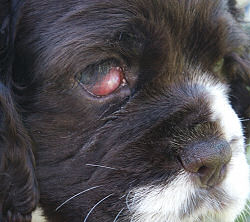 This is what's known as a "cherry eye", or a prolapsed gland of the third eyelid.
It happens to a lot of Cockers, as well as to certain other breeds such as Bulldogs and Shar Peis.
This is what's known as a "cherry eye", or a prolapsed gland of the third eyelid.
It happens to a lot of Cockers, as well as to certain other breeds such as Bulldogs and Shar Peis.
What has happened is that a gland (which is normally tucked under where you
can't see it) has popped out. This is basically a cosmetic problem, and
nothing to panic about as long as you don't just let it stay that way. If
you do nothing, it could get irritated and infected.
In many cases, you can very easily fix a cherry eye yourself. This has the
highest chance of working if you do it within minutes or hours of first
noticing a cherry eye. All you need to do is wash your hands first, and
then gently massage the bulging gland back under the lower eyelid where it
belongs. In many cases, you can get the prolapsed gland back under where
it belongs, and in many cases it will stay there.
If you can't pop the cherry eye back in by yourself, you'll need to have your
vet do a surgical fix. This typically costs at least a couple of hundred
dollars. There are several different surgical procedures that vets can do
to fix cherry eyes, but I have a strong suggestion on which way you should go.
Many vets will try to get you to agree to a removal of the prolapsed gland, but
this is a VERY bad idea. This is the way it used to be done in the old
days, and many older vets are only comfortable with this procedure because
that's the way they have always dealt with cherry eyes. Others prefer this
procedure because it is the easiest (and cheapest) surgical method of dealing
with cherry eyes. But the reason that removal of a prolapsed gland is such
a bad idea is that this gland is responsible for production of a significant
portion of the tears that lubricate the eyes. Without the gland, the dog
is very likely to have dry eyes, and this CAN lead to significant problems down
the road... even blindness.
A better way to go is to have your vet stitch the prolapsed gland back in place
where it belongs. This is sometimes known as "the pocket technique"
because the prolapsed gland is tucked back in to a pocket under the eyelid, and
then a single stitch is used to anchor it down in place. Because the gland
is not removed, it still produces tears... and because it is anchored with
a stitch, it generally doesn't pop back out.
So my strong advice if you can't massage a cherry eye back in place yourself, is
to locate a vet that is experienced in performing "the stitch" or "pocket
technique" style of cherry eye repair. Don't let your vet talk you in to
removal of the gland, and don't let your vet do the repair unless they have done
it many times before. Getting it done correctly is important enough that
you should definitely call around to locate the right vet to do the job if your
regular vet isn't up to the task.
If anyone tells you that a cherry eye should be surgically removed -- even if
it's a vet that tells you -- it should be an instant red flag that the person is
way out of touch with the current state-of-the-art in cherry eye treatment.
Don't believe me?
Click here to read what the experts at the American College of Veterinary
Ophthalmologists have to say about it.
-
 My lawn has many circular patches of dead grass from where my dog has peed on it. Is
there something I can feed to the dog to make his urine less acidic so that my lawn will stay green?
My lawn has many circular patches of dead grass from where my dog has peed on it. Is
there something I can feed to the dog to make his urine less acidic so that my lawn will stay green?
Actually, the easiest solution to this problem is just to water the lawn more often and/or to water the lawn
for longer periods of time. The extra water given to the lawn will dilute the urine to the point where
it will not kill the grass. Our lawn looks pretty nice, and we have five dogs peeing on it.
We just water that particular lawn a little heavier than we would if we did not have dogs on it.
-
What do you recommend feeding to a Cocker Spaniel?
Over the years, we have experimented with many of the major
brands of pet food... such as Purina Pro Plan, Eukanuba, Canidae, Blue
Buffalo, Natural Balance, and Taste Of The Wild. Some of those foods we
fed for years, all for at least a few months to see how our dogs reacted.
One of our dogs, "Morgan", seemed to have a very sensitive stomach and very
sensitive skin. She was prone to food allergies. Out of all the
different foods, the one that seemed to work best for our sensitive dog was
Blue Buffalo.
By the way... if your vet tries to talk you in to buying some special food
that is only available at his office... his motivation is probably based
more on profit than on trying to help you or your dog. Your Cocker will do
fine (and you won't go broke) by saying "no" to the vet's brand and sticking
with a quality food such as Blue Buffalo.
- How can I find a Cocker Spaniel breeder in (name of state)?
You can check
the American Spaniel Club web site
for ASC members who breed Cockers in your state. But be forewarned... most of the breeders that the American Spaniel Club
recommends are breeders of show dogs... and they tend to like to place their puppies with other people who are involved in the
show world. Your best technique for success with a show dog breeder is to let them know that you are not looking for a show dog,
just a pet... and to ask if they know where you can find a good pet Cocker puppy in their area.
When contacting breeders, there is a simple litmus test you can use to quickly
assess whether you are dealing with a good breeder or not. Ask them if
they do
O.F.A. and C.E.R.F. testing to their adult dogs. If they assure you
that the parents of their puppies are always required to pass O.F.A. and C.E.R.F.
tests prior to breeding, you are more than likely dealing with a good breeder.
If they don't know what you are talking about when you mention O.F.A. and
C.E.R.F. tests, or if they try to convince you that O.F.A. and C.E.R.F. tests
are not necessary... you should quickly move on to dealing with a
different breeder.
- I have heard that it's not a
good idea to buy a puppy from a pet store. Why not?
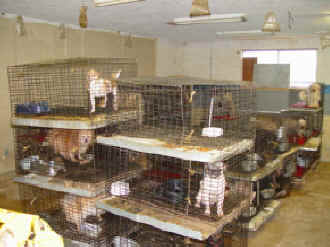 There are several reasons. First, almost all pet store puppies come from puppy mills... very large commercial breeders
with huge numbers of dogs bred strictly for profit. If you saw the conditions the parent dogs live their entire lives in...
you would be very upset. It's awful that these type of operations are allowed to stay in business. You keep them in
business when you give your money to pet stores that sell puppies.
There are several reasons. First, almost all pet store puppies come from puppy mills... very large commercial breeders
with huge numbers of dogs bred strictly for profit. If you saw the conditions the parent dogs live their entire lives in...
you would be very upset. It's awful that these type of operations are allowed to stay in business. You keep them in
business when you give your money to pet stores that sell puppies.
Besides the conditions the parents are kept in, you need to also consider the puppies. A puppy should be spending lots of time with
people... so it gets properly socialized and ends up calm and well behaved when people are around. Pet store puppies live in
cages... they get almost no attention at all... and by the time they get to their new owners they are so starved for attention
that they tend to be hyper, misbehaved, and so excited to finally see someone that they lose bladder control. Also, pet store puppies
generally tend to come from lower quality breeding lines than the dogs from a reputable breeder who sells directly to the public.
The other reason we are just completely philosophically opposed to pet stores that sell puppies is because they will sell a puppy to
anyone. If someone's got the money, a pet store is going to sell them a pup with no questions asked. The sad truth is that not
everyone should be a dog owner. Good dog breeders will make a good match between a dog and his new owners... and will refuse to
sell a puppy to people who don't have what it takes to take care of that dog every day for the next fifteen years. Certain people...
college students, people who live on the 3rd floor of an apartment building, people operating pre-schools out of their homes...
should probably not own a dog, at least not a Cocker Spaniel. There are many times that people will email me about buying a puppy
and I'll write back and politely suggest a cat instead. Would a pet store have turned their business down?
- I bought a purebred puppy from a pet store, and when they gave me his registration papers
it wasn't an AKC registration, it was a UKC registration. What's up with that?
 Most reputable breeders will use the American Kennel Club for registration. A lot of the puppy mills can't pass the AKC's
inspections, so they register their dogs with the Universal Kennel Club or the Continental Kennel Club instead. I'm not saying
every breeder that uses the UKC or the CKC is un-reputable, and I'm not saying that every breeder that uses the AKC is reputable...
I'm just saying that one red flag indicating that you might be looking at a puppy from a bad breeder is registration with someone
other than the AKC... or no registration at all.
Most reputable breeders will use the American Kennel Club for registration. A lot of the puppy mills can't pass the AKC's
inspections, so they register their dogs with the Universal Kennel Club or the Continental Kennel Club instead. I'm not saying
every breeder that uses the UKC or the CKC is un-reputable, and I'm not saying that every breeder that uses the AKC is reputable...
I'm just saying that one red flag indicating that you might be looking at a puppy from a bad breeder is registration with someone
other than the AKC... or no registration at all.
Please note that for dogs bred in Canada, the Canadian Kennel Club is the organization that most reputable breeders use for
registration. Be sure not to confuse the two CKC organizations... the Canadian Kennel Club and the Continental Kennel
Club. I'm sure one of the reasons that the Continental Kennel Club chose their name is to try to ride on the
coat-tails of the Canadian Kennel Club.
- Why is there such a wide difference in the pricing of Cocker Spaniel puppies?
I've talked to some breeders who sell their puppies for over a thousand dollars, yet I've seen others advertised in the newspaper
or on the Internet for as little as four hundred.
Reputable breeders usually charge a lot more for puppies because they have incurred costs that the backyard
breeders and puppy mills have not. For example, the cost of doing proper hip and eye exams on each and every dog in their
breeding program. Do you think the guy advertising puppies for sale in the local newspaper has gone to the expense of
having hip x-rays taken to ensure that his dogs are not passing along genetic hip problems? Not a chance. Doing just
that one test can cost several hundred dollars if the vet needs to anesthetize the dog to get a good x-ray.
 I'll give you another example of the expenses involved. Several years ago, we decided to import a dog from one of the top
Cocker breeders in the world. We paid the breeder to personally bring the dog to us all the way from Buenos Aires, Argentina.
We raised that dog until he was two years old... at which time we paid for hip and eye testing to ensure that he was free of
genetic defects before breeding. Unfortunately, a genetic hip defect was found, and the dog had to be neutered without ever
creating a single pup. So we managed to incur a lot of costs over the two years we spent with the dog, but he never made a single
puppy. And that's OK with us... we'd rather do things that way instead of not doing the testing and then finding out
ten years later that we've made large numbers of puppies who grew up to have lifelong hip problems.
I'll give you another example of the expenses involved. Several years ago, we decided to import a dog from one of the top
Cocker breeders in the world. We paid the breeder to personally bring the dog to us all the way from Buenos Aires, Argentina.
We raised that dog until he was two years old... at which time we paid for hip and eye testing to ensure that he was free of
genetic defects before breeding. Unfortunately, a genetic hip defect was found, and the dog had to be neutered without ever
creating a single pup. So we managed to incur a lot of costs over the two years we spent with the dog, but he never made a single
puppy. And that's OK with us... we'd rather do things that way instead of not doing the testing and then finding out
ten years later that we've made large numbers of puppies who grew up to have lifelong hip problems.
Trying to keep puppy prices low is usually not the main goal of a good breeder. The goal is to breed healthy puppies that meet the breed standard and that
make excellent pets. I won't bore you with a full accounting of every expense
I had during my 15 year breeding program in order to meet that
goal, but I will say that it was an expensive journey. Breeding puppies
was never a business for me, it was my hobby... so
I was not looking to put my kids through college on profits from selling puppies. But given the expenses involved in breeding
puppies the right way, I did have to sell my puppies for more than a few hundred dollars if
I ever wanted to come close to breaking even.
- I'm impressed with all the beautiful pictures on your web site.
What kind of camera do you use?
 I have owned eight different digital cameras over the years. So, the pictures you see here on the web site have
been taken with many different cameras. The camera I'm currently using is a Canon EOS
80D... which is a pretty amazing camera... but not for everyone.
A much better choice for the average person is the Canon Digital Rebel. If
you want to get great pictures... it's one heck of a nice tool.
I have owned eight different digital cameras over the years. So, the pictures you see here on the web site have
been taken with many different cameras. The camera I'm currently using is a Canon EOS
80D... which is a pretty amazing camera... but not for everyone.
A much better choice for the average person is the Canon Digital Rebel. If
you want to get great pictures... it's one heck of a nice tool.
If you can't afford a Canon digital SLR or don't want to carry around a large
camera like that... check out
Canon's line of point-and-shoot cameras. Canon makes really great
digital cameras, even the simple point-and-shoot models.
- One of your pictures is just perfect for a project I'm working on.
May I use the picture? I'll give you full credit as the photographer!
Maybe yes, maybe no. What I'd like you to do is
send me an email and explain to me who you
are, what photo you're interested in, what you want to do with it, and whether or not you are prepared to send me
anything in return for use of the photo. Right-click on the photo you're interested in, select PROPERTIES, and
copy the URL of the image. Paste the URL in your email so I know what photo we're talking about.
When a very large company wants to use one of my photos, I expect to be paid a for use of the photo. When a non-profit group
wants a photo, or when a student wants to use a photo in a school project... I don't expect anything but a
"thank you". It's the small businesses in the middle that fall in to a grey area. Small businesses, by their
nature, are looking to make a profit. It's just not fair to expect me to give you my photo for free so you can make the
profit... so, I do always ask for something in return. Sometimes we agree on a small amount of money... enough
to take Mrs. Zim out for a meal somewhere... or sometimes I just have the person send me a small piece of merchandise, such as
one of their company's products or something with their company logo on it.
-
That "Cocker Street" sign is wonderful! Where did you find that?!?
 You think I would live anywhere else?
Actually, I hate to take the mystery out of it... but it's a fake. I spotted CROCKER Street one
day in the city of Templeton, California, and snapped a photo of the sign. It took about two minutes
of digital manipulation on the computer to "fix" the sign the way I think it should have been!
By the way, if you see this photo anywhere else on the Internet, you'll know who they stole it from.
- I can't thank you enough for the information about (ear infections,
cherry eye, potty training, whelping, whatever) on your web site. It was really helpful. Is there something
nice I could do for you as a thank you?
I always appreciate
an email that mentions something in particular that you found useful on the web site.
Keeping our web site online costs several hundred dollars every year... but it's all paid for by people like you
who are appreciative and want to help cover the costs. You can make a direct donation if
you'd like, but there's an even easier way to help us with web server costs that doesn't involve spending any money you
wouldn't normally spend.
We've got a partnership with Amazon.com that pays a commission on any Amazon purchases made as a result of referrals
from our site. At the bottom of every page on this site, you'll see a banner ad for Amazon.com. If you just
click on that banner ad, it takes you to Amazon's site, and any purchases you make at that point will result in a
commission heading our way.
Anytime you're thinking about making a purchase at Amazon... if you'll just think of us first... come to our
site and click one of the Amazon ads at the bottom of the page... and let that be the way you get to Amazon,
you'll be helping cover the cost of keeping my site online. In fact, thanks to nice people like you who have been
great about using our Amazon links, this web site has been 100% financially self-supporting for quite a few years now.
-
There are so many puppy pictures on your web site... it looks like you've had a LOT of puppies. The truth is that
you're just running a glorified puppy mill, right?
If I'm running a puppy mill, I'm doing a terrible job of it!
First off, we haven't had a litter since 2010. But even back in the days
when we were breeding our dogs, we usually just had one litter of puppies a year. That was the case in 2008, 2006, 2005, 2004, and 2003.
In 2009, we didn't have any litters at all! Over the fifteen year period
where we bred Cockers, we had a total of sixteen litters. While I
have taken lots of pictures of my puppies over the years, the litters have been few and far between. This
was
just a hobby, not how we made a living.
We also would do hip and eye tests on our adult dogs before breeding. Puppy mills never go to the expense of doing that to
their dogs. If health problems popped up in our puppies, we spayed & neutered the parents... even if it meant we didn't
have any dogs to breed for a while.
If you go to a breeder's web site and you see that they have puppies available from several different litters at the same time...
this is a red flag that you may be looking at a puppy mill. Other red flags include the Visa/Mastercard logo on their site, a
willingness to ship a puppy to anywhere in the world, or that they offer several different breeds of dogs. Generally speaking,
if you see that a breeder owns a champion show dog, or they talk about OFA or CERF testing... you can figure right away it is not
a puppy mill.
-
 I found a stray Cocker just wandering the streets. I can't find his owners, and I can't keep him any longer. If I drive
him to your house, can you take care of him?
I found a stray Cocker just wandering the streets. I can't find his owners, and I can't keep him any longer. If I drive
him to your house, can you take care of him?
No... I'm sorry, but I can't.
There's a very good Cocker rescue group in
Santa Barbara, California, as well as dozens of Cocker rescue groups
throughout the rest of the USA. That's who you should be talking to.
- We're going to be in Grover Beach for a vacation and, while we're there, we'd like to stop by your house and
meet your dogs. Can you send us directions?
Sorry, I'm going to have to pass! My weekends are too
short as it is... I have no interest in opening up my home to every Cocker
lover that happens to pass through town. Plus, we moved out of California
in 2020. We now live way off the beaten path... in Pasco,
Washington.
-
I have a solid buff colored female Cocker and my neighbor has a black & white parti colored male.
We would like to make some puppies. What colors would the puppies be?
Mating those two dogs would be a bad idea. The general rule is to breed partis to partis, and solids to
solids. If you breed a parti to a solid, the result will be what the show breeders call "mis-marked" puppies.
In other words, mostly solid color dogs that have goofy patches of white in places where they shouldn't be.
If you're going to get in to breeding Cockers, you have a moral obligation to create puppies that meet the breed standard as set
forth by the American Spaniel Club. If you breed a solid to a parti, you will almost surely get some puppies with markings that
don't meet the standard.
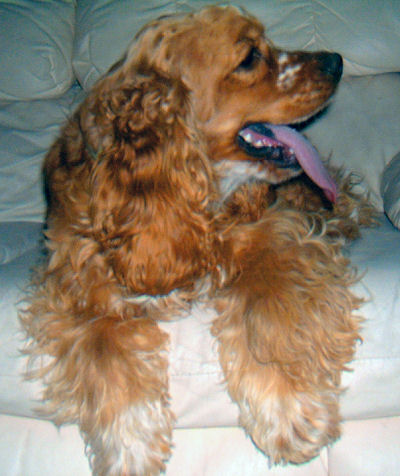
A mis-marked solid color.
This is what happens when a parti is bred to a solid.
See the white markings on the snout, neck, and feet?
That's a no-no... according to the breed standard.
-
I have a female Cocker that is pregnant. I don't know anything about
helping puppies to be born. Can you give me any tips?
I've learned a lot about delivering puppies over the years. Check out
my whelping page for some information that we think you'll find really useful.
But be forewarned... I've got a very graphic picture there of a puppy being born... and if you get grossed out easily,
it might make you uncomfortable. Personally, I think it's an amazing picture, but others have said it was a bit of reality that
they didn't necessarily want to see!
Feel free to send me an email with any specific questions you have regarding whelping puppies,
and I'll be happy to respond. Just remember, I might not respond for a day or
two... so don't send emergency questions! Call your vet with those.
-
I have a one year old male Cocker that I am interested in breeding. Would you like to use my male
dog as a stud for one of your females? If not, how can I find someone who would?
First off, your dog is too young to breed. Sure, he is certainly physically capable of breeding at
that age, but responsible breeders generally don't breed dogs that are younger than two years... for several reasons.
Without waiting at least until the age of two, you have not allowed enough time for health problems to pop up. The idea is to
wait at least two years to make sure that your dog is generally healthy. The other issue is genetic health tests for eye and
hip diseases.
The Orthopedic Foundation For Animals
will not certify hip tests on any dog younger than two years of age.
Realistically, the chances of finding a female in need of your male's services are low. Any serious
breeders would already have a male of their own and even if they didn't they would probably be looking
more for a champion show dog for a stud, rather than using someone's pet.
Which leaves you with the non-serious breeders. The thing I would like you to think about, though, is that perhaps it would be
better to leave the breeding to the serious breeders. The serious Cocker breeders do the appropriate genetic health tests before
breeding to make sure that they are not creating new generations of Cockers with serious genetic defects such as eye and hip
diseases. The serious breeders generally also make sure that they are breeding the right Cockers... ones that fully meet
the breed standard... not just whatever pet quality Cocker that they happen to have around.
Finally, the serious breeders are experienced enough to know what to do to ensure the health of both the mother dog and all of her
puppies. Puppy birth is a serious situation and is full of dangers to the pups. There is a reason that dogs have such
large litters... it is quite normal for several puppies in every litter to die during the first few days. Experienced
breeders will know how to minimize or prevent this. Believe me when I say that if you are interested in breeding your dog
because of "the joy of birth"... nothing will burst your bubble like watching several puppies die in the first few
days... especially if that happens after you've paid $500 or so to the emergency vet in a futile attempt to save them.
-
We have a two-year-old female Cocker and an eleven-month-old male. We have several friends and family members
who are interested in a puppy. My question is: is our male dog old enough to breed?
Your male dog is probably old enough that he could physically do the job of getting your female dog
pregnant... but most good Cocker breeders do not breed a dog until he is much older. The good breeders usually wait
until both dogs are at least two years old before breeding. There are two main reasons for this...
First, you want to allow some time for any major health problems to show up. You don't want to breed a dog with major health issues,
and at your male dog's age you might not even realize it yet if he has any. For example, cataracts. They
almost never show up at eleven months.
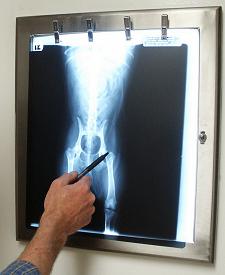 The bigger reason has to do with testing to determine if the dog is a carrier for genetic hip diseases. There is a very simple
x-ray screening that you can do to determine if the dog has genetic hip dysplasia that might be passed along to the next generation.
You have your vet take the x-ray, then you send it off to an organization called
the Orthopedic
Foundation For Animals and they have their panel of hip experts evaluate it. Again, it takes a while for hip disease to show
up... so the OFFA will not do evaluations on any dog younger than two.
The bigger reason has to do with testing to determine if the dog is a carrier for genetic hip diseases. There is a very simple
x-ray screening that you can do to determine if the dog has genetic hip dysplasia that might be passed along to the next generation.
You have your vet take the x-ray, then you send it off to an organization called
the Orthopedic
Foundation For Animals and they have their panel of hip experts evaluate it. Again, it takes a while for hip disease to show
up... so the OFFA will not do evaluations on any dog younger than two.
So, the way it works with most good breeders is that they wait for their dogs to turn two years old, then they have a Veterinary
Ophthalmologist do an eye exam to check for any hereditary eye problems which might be passed along to puppies. If the dog passes
the eye test, the breeder has their vet do hip x-rays to look for hereditary hip defects. The hip x-rays are sent to the OFFA, and
if they get a good evaluation back (and if no other major health problems have cropped up) they then proceed with breeding the dog.
Of course, most backyard breeders do not do any of this... and no puppy mills do this... and this is why it is generally
much safer to buy a dog from a reputable "hobby" breeder than from a backyard breeder or a pet store.
-
I read your funny comments regarding how to tell if my Cocker is addicted to
tennis balls. My Cocker doesn't show any interest in retrieving tennis
balls, or anything else for that matter. Is this normal?
 Some dogs are so ball-crazy that they just do it naturally from day one. Others
don't. It just depends on the dog.
Some dogs are so ball-crazy that they just do it naturally from day one. Others
don't. It just depends on the dog.
You can actually train a dog to retrieve things. Start with whatever his
favorite chew toy is. Get him chewing on it, then grab it and throw it
about a foot or two away. Keep working at it as long as it takes to get
him to go over there and get it.
Once you've got him retrieving it from a foot away, just gradually increase the
distances each time. Depending on how much natural retrieving instinct he
has, you may have to gradually work on this over days or weeks. When
you've got him consistently retrieving his favorite chew toy from across the
room, switch to other toys such as squeaky toys or balls. Gradually throw
them farther and farther away, and in time you will have the dog trained to
retrieve the toy from as far as you can toss it.
I highly recommend training your dog to retrieve things... it's great
exercise for the dog, and will help to tire him out for the "quiet time" you
need to get things done around the house. The other great thing about it
is that while the dog is running his little butt off, yours can be planted
firmly in a chair. The dog has to do all the work, and you just sit back
and watch. It's much like being in Management!
- Where would I find a Cocker with no legs?
Right where you left him!
(If you think that's funny, check out my dog jokes page.)
- Do Cockers get along with cats?
Most Cockers will chase anything that moves, and cats tend to run at the first sign of trouble, so don't
expect miracles. If you've got a really mellow Cocker that moves slowly and doesn't tend to run around
like a maniac, you might have a chance. Here are a few things you can do to help a friendship develop:
The most important thing is to introduce your cat and Cocker to each other SLOWLY and in a carefully controlled
way. Get the dog totally tired out before you put them together the first few times. Don't hold the
cat... if it freaks out, you're going to get severely clawed. Finally, make sure the cat has a safe
place to escape to if things go badly. Here's a few pictures that people have sent me to illustrate that
it can work under the right circumstances:
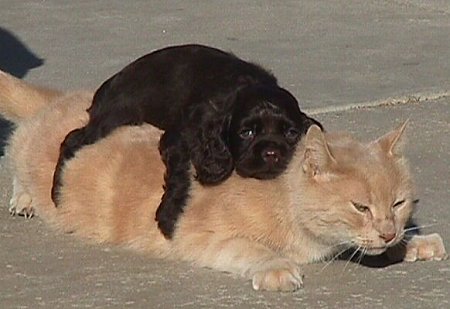
This pup knows a good pillow when he sees it!
Owner: Gene and Dawne Christy of Hi-Acre Cocker Spaniels
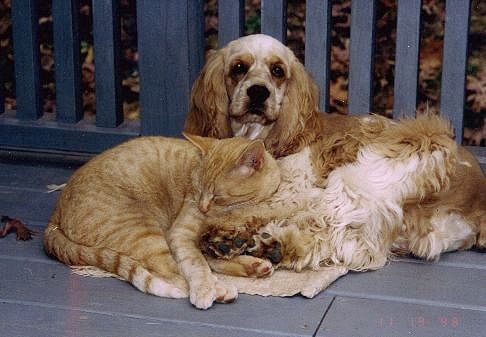
"Casey" with "Speedy" the cat
Owner: Lana Poole -- Tell City, Indiana
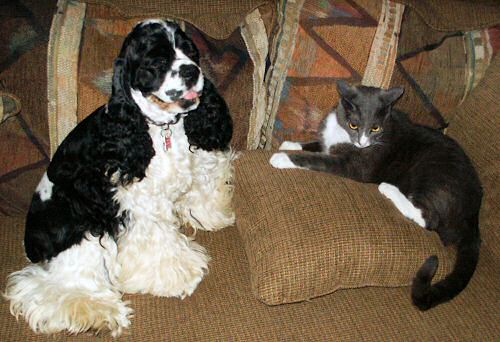
Our girl, Morgan, with our cat, Socks
Why do Cockers always have their tails chopped off?
 It's called tail docking, and there are actually a few reasons it is done. It started back in the days
when Cockers did a lot of hunting in the brush, and their tails would get full of burrs and thickets. But
there are still plenty of good reasons to dock the tail of a pet Cocker:
It's called tail docking, and there are actually a few reasons it is done. It started back in the days
when Cockers did a lot of hunting in the brush, and their tails would get full of burrs and thickets. But
there are still plenty of good reasons to dock the tail of a pet Cocker:
First, Cockers wag their tail so vigorously that they can actually hurt themselves by either hitting their
tail against their own body or by hitting it in to things such as walls or furniture. Another reason is
that a full, bushy tail tends to get dirty with fecal matter. Finally, Cockers are a small breed with
a BIG tail... and it just plain looks goofy because it's out of proportion to their bodies.
That picture of the puppy with
her tail wagging is so cute! How did you do that?
The picture is an animated .gif file. I made it using animation software called JASC Animation
Shop... which, unfortunately, is no longer available. It used to come bundled with Paint Shop Pro. I've been a
Paint Shop Pro user for a long time... and have used it to edit and tweak many of the pictures on this web site. You
may have heard people talk about editing pictures with Adobe Photoshop. Paint Shop Pro is almost every bit as powerful...
at about one fifth of the price! Anyway, back to the question of how to make a picture with movement like the tail
wagging picture... find a software program that can create animated GIF files.
There is a LOT more to this web site than just this page!
Please explore the rest of the site by viewing our table of contents,
or by clicking on one of the quick links below.
All About Our Cockers
Meet Jim Zim
Contact Jim Zim
Copyright ©2021 Jim Zimmerlin, Grover Beach, California. All rights reserved.
